Butter Croissants and Coffee

One of the most best aromas on a beautiful morning

Samosa Chaat

Snack a little

Seekh Kabab

Try something different!

Decadent Chocolate

Do not forget to indulge once in a while

Steamed goodness

Various cooking methods bring variety in your palette

Showing posts with label Stovetop. Show all posts

Sunday, April 3, 2016

Kappa Vevichathu / Kappa puzhukku - Mashed Yuca with Coconut & Spices


Ingredients:
Yuca or tapioca root - 2 lbs. (1/2 kg)
Turmeric powder - 1/4 tsp
Grated coconut - 1/2 cup
Pearl onions - 2
Green chillies - 4
Garlic - 1 clove
Cumin seeds - 1/4 tsp
Curry leaves - 1 sprig
Oil - 1 tbsp
Mustard seeds - 1 tsp
Salt to taste
Water as needed

Method:
First remove the skin off the yuca root and chop it into bite size pieces. Put them into a saucepan. Add a pinch of turmeric, salt and enough water to cover the yuca pieces. Boil the yuca till the water evaporates, and the yuca is soft.

Grind grated coconut, turmeric powder, cumin seeds, pearl onions, garlic, green chillies and 1/2 a sprig of curry leaves into a coarse paste.

In a pan, heat a tablespoon of oil. Add mustard seeds and let them crackle. Add the remaining curry leaves. Then add the coconut mixture. Stir and fry it for 3 minutes.

Add the mashed yuca. Combine and cook for about 5 minutes. Add some water if you want to adjust the consistency to your liking. I added about half a cup of water since the yuca was dry.

Serve warm with some Kottayam fish curry or beef curry. Yum!

Quinoa Cauliflower Biryani


I got introduced to quinoa sometime last year, as a great substitute to rice. Its gluten-free, high in fiber and is a complete protein that provides all nine essential amino acids for good health. Its not technically a grain but still counts as a 'whole grain' food. After learning all its benefits, the only question was how best to use it in recipes. Biryani is my favorite dish in the world, but I always make a meat-based biryani. So this time I tried a vegetarian biryani using cauliflower and peas, and substituted the rice for quinoa. Turns out its pretty good! Has all the flavors of a good biryani, and you won't die of guilt.

Ingredients:
For quinoa:
Rainbow Quinoa - 1 and 1/2 cup
Green Cardamom seeds - 1/2 tsp
Black cardamom - 1
Cloves - 3-5 pcs
Cinnamon stick - 1 inch piece
Bay leaf - 1
Water - 2 and 1/4 cups
Salt to taste

For cauliflower:
Cauliflower florets - 2 cups (from one head)
Green peas (fresh or frozen) - 1/2 cup
Ghee/oil - 1 tbsp.
Onion - 1 large, thinly sliced
Green chilli - 3 or 4, thinly sliced
Ginger - 2 tbsp, minced fine
Garlic - 3-4 cloves, minced fine
Cumin seeds - 1 tsp
Green Cardamom seeds - 1/2 tsp
Cloves - 3-5 pcs
Cinnamon stick - 1 inch piece
Bay leaf - 1
Garam masala - 1/2 tsp
Coriander powder - 1 tsp
Chilli powder - 1/2 tsp
Turmeric powder - 1/4 tsp
Yogurt - 1 and 1/2 cup
Salt to taste
Cilantro and mint leaves - a handful each, chopped coarsely

For garnish:
Cashews, almonds, raisins, dried cranberries, thinly sliced onion - a handful or as per your liking
Ghee - 2 tbsp
Milk - 1/2 cup
Safrron strands - a good pinch
Turmeric powder - a pinch
Garam masala - 1 tsp
Cilantro and mint leaves


Method:
First fry all the ingredients for garnish, one at a time in some ghee. First the almonds, then the cashews, then raisins, then cranberries and finally finely sliced onions. Collect them all in a bowl and mix.


For the Quinoa:

Wash the quinoa thoroughly and drain. In a large saucepan, add a teaspoon of oil or ghee. Add cardamom seeds, black cardamom, cloves, cinnamon and bay leaf. When you get a good aroma, add the washed quinoa and fry for 2-3 minutes. Then add some salt (about a teaspoon) and water. Cover and cook on medium heat until it comes to a boil, then reduce heat to low and cook for about 10 minutes, until most of the water has been absorbed. Then turn the heat off and let sit for 5 minutes. Then fluff with a fork.

For the Cauliflower:
In a dutch oven, add oil or ghee and heat on medium. Add cumin seeds, cardamom seeds, cloves, cinnamon stick and bay leaves. When you get a good aroma, add the onions, ginger, garlic and green chilies. Saute on medium heat until onion turns golden. Add coriander powder, chili powder, turmeric and garam masala. Fry for a few minutes until the raw smell dissipates. Add about half a cup of water, salt and mix. Add cauliflower and peas. Also add the cilantro and mint (save some for final garnish). Give it a good mix. Cover and cook until cauliflower turns tender but still has a slight crunch, about 10 minutes. Turn the heat to low, and add the yogurt and gently stir it in. Keep stirring so the yogurt doesn't split, and cook for about 5 minutes.

Final assembly:
Heat the milk in a bowl and add turmeric powder and saffron strands.
In a deep pan or dutch oven, first add a layer of quinoa. Sprinkle some saffron turmeric milk and garam masala. Then add a layer of the cauliflower gravy. Sprinkle with the nut mixture. Repeat the process until you have a final layer of quinoa. Add the last of the saffron turmeric milk and nuts. Finally garnish with mint and cilantro. Cover tightly with a lid. You can bake this at 350 degrees F for 15-20 minutes, or cook on low heat for about 20 minutes. Let it sit for 10 minutes before serving. Sprinkle some lemon juice on top for added flavor, but its optional.
Serve hot with raita, pickle and pappadums!
Enjoy!


Thursday, March 3, 2016

Shrimp curry in coconut milk

This simple shrimp curry is my go-to recipe when I want something comforting, quick and easy. There's hardly any prep involved if you buy peeled and deveined frozen shrimp. It uses very few ingredients, so I usually make this when I'm short on fresh produce.

Ingredients:
Shrimp - 1 pound, peeled and deveined
Onion - 1 large
Ginger - 1 inch piece
Garlic - 2 to 3 large cloves
Fresh chillies - 3 or 4 (green or red)
Curry leaves - 1 sprig
Tomato - 1 large
Red chilli powder - 2 tsp
Turmeric powder - 1 tsp
Garam masala - 1/2 tsp
Coriander powder - 1 tbsp
Cinnamon - 1 inch piece
Cardamom seeds - 1/2 tsp
Cloves - 4 or 5
Fennel seeds - 1 tsp
Oil - 2 tbsp
Salt to taste

Method:

Wash and clean the shrimp. In a bowl, add the shrimp, 1 tsp red chilli powder, 1/2 tsp turmeric powder, 1/2 tsp garam masala and 1 tsp salt. Mix and keep aside to marinate.
Meanwhile dice the onions, ginger, garlic and tomato. Slit the chillies in half.
In a large pan, heat a tablespoon of oil.
Add whole spices - cinnamon, cloves, cardamom and fennel seeds.
Then add the onions, ginger, garlic, chillies and curry leaves. Add some salt. Fry until onions turn translucent.
Now add a teaspoon of red chilli powder, one tablespoon of coriander powder and a pinch of turmeric powder.
Once the spices have fried in the oil, add the chopped tomato. Cover and cook for about 5 minutes till the tomato turns soft.
Then add a cup of water to the mixture and 1/2 a cup of coconut milk. Gently stir on med-low heat so the coconut milk doesn't split, but we want to heat it through.
Now add the shrimp and the remaining coconut milk. Cover and let simmer for about 10 minutes.
Do not let the curry boil or it could split the coconut milk.
Serve hot with some steamed white rice.

Monday, November 16, 2015

Spicy Cumin Beef


Food hopping in NYC is one of our favorite things to do. One spot we never fail to miss is Cafe China in Manhattan. I first came across this place while watching Unique Eats on the cooking channel. They specialize is Sichuan cuisine, so its quite spicy that appeals to our tastebuds. I guess it's because my husband went in with low expectations thinking nowhere in America can you find the real spicy food. This blew him away, so much that he actually craves for it! Lol!
One of our favorite dishes is the spicy cumin lamb, apart from their dan dan noodles, chungkiang chicken and 3 pepper chicken. The lamb is personally my favorite. I also heard about Xian Famous foods being quite popular for their spicy lamb noodles, and spicy lamb burger. So on our anniversary this year, we stopped by to see if it was as good as Cafe China. Pretty spot on I gotta say!
Now that we've tried this thing in a couple of different places, I had to try and make it at home. I didn't have lamb on hand unfortunately, so used thinly sliced beef instead. I was amazed at how simple it was to make this dish. Now I gotta find me some lamb next time!


Ingredients:
Beef - 1 lb.
Cumin seeds - 2 tbsp
Sichuan peppercorns - 1 tsp
Onion - 1, medium
Garlic - 2 tsp, minced
Green chillies - 3 small or one large bamana pepper - sliced thin
Scallions - 2 stalks, chopped (separate whites from green part)
Cilantro - handful, coarsely chopped (almost whole sprigs)
Chilli oil - 4 tbsp.
Salt - a pinch
Baking soda - 1 tsp
Tapioca starch or corn starch - 2 tbsp
Chinese 5 spice powder - 2 tsp
Cumin powder - 2 tsp
Chilli powder - 2 tsp
Hoisin sauce - 1 tbsp
Light soy sauce - 1 tbsp
Chingkiang vinegar (chinese black vinegar) - 1 tbsp
Shaoxing rice wine - 1 tsp

Method:
Toast sichuan peppercorns (1 tsp) and cumin seeds (2 tbsp) in a pan on medium heat. Grind coarsely.
Cut beef in thin slices (bite size). Add salt, cooking oil, baking soda, tapioca starch, 5 spice powder, and cumin powder. Mix thoroughly.
Chop up some onion (large chunks), cilantro with stalks and scallions.
Mix hoisin sauce, soy sauce, chingkiang vinegar, shaoxing rice wine and a teaspoon of chilli oil in a bowl and keep aside.
Cook beef in chilli oil in a large wok on high heat. Set aside. Do not put all the beef in at once. I cooked small amounts in 5 batches, or the wok will cool down quickly and the beef with stew rather than sear and toughen up.
After taking out all the beef, coat surface of wok with oil and add green chilies, garlic, onion and chili powder.
Then add beef/lamb, cumin & sichuan peppercorns, and cilantro. Add sauce mixture. Stir fry for another 4 minutes till sauce is absorbed by the beef. Serve hot with steamed rice, noodles or even in a bun.

Sunday, March 8, 2015

Olan


Ingredients:
Ash gourd - 2 cups, cubed
Red beans - 1 cup - soaked overnight and cooked with salt
Coconut milk - 1 cup (preferably fresh, not canned)
Green chillies - 3 - 4, slit in half
Curry leaves - 2 sprigs
Cumin powder - 1/2 tsp
Coconut oil - 1 tbsp
Mustard seeds - 1 tsp

Method:

Cook red beans with some salt and keep aside.
Cook ash gourd with very small amount of water and salt, covered on medium heat.
Once half cooked, add the red beans and cook uncovered until almost all water has evaporated.
Add coconut milk, leaves and cumin powder. Continue heating until it just starts to boil. Stop the heat and take it off the stove.
Heat coconut oil and splutter mustard seeds.
Add the oil into the olan. Serve with rice.

Chinese chicken dumplings


Ingredients:
Minced chicken - 1 lb.
Shitake mushrooms (dried, soaked and squeezed dry) - 1/4 lb. (half a packet)
Napa cabbage - 5 leaves, shredded (marinated for 20 mins with salt and squeezed)
Sambal - 1 tbsp
Garlic - 1 clove, minced fine
Ginger, minced - 2 tbsp
White pepper powder - 2 tsp
Scallions - 2 stalks, minced fine
Hoisin sauce - 2 tbsp
Light soy sauce - 2 tbsp
Lime zest - 1/2 tsp
Sesame oil - 2 tsp
Gyoza wrappers - 1 packet

Method:

Mix all ingredients except wrappers. Marinate in refrigerator for at least half an hour.

Fill a small bowl with water.
To assemble dumplings: Spoon 1 teaspoon of chicken mixture and place into center of wrapper. Dip the tip of your finger into the small bowl of water and run your finger along the edge of the wrapper. Fold the wrapper over to create a half moon shape, or a triangle if using square wrappers. Pinch the edges of the wrapper starting in the middle to seal, making sure all air has been removed.

To cook dumplings: Place a steamer lined with baking paper over simmering water.
Cook dumplings, in batches, for 15 minutes or until tender and cooked through. Serve.

Sunday, December 22, 2013

Blanquette de Veau - Veal Stew


I picked up some veal stew meat on one of my trips to the grocery store. With the cold weather outside, I felt like having something warm and comforting for dinner. I looked up a few veal recipes on Epicurious and elsewhere on the web, and I decided to go with the Blanquette de Veau. It's a French dish which basically means veal stew. The rule is to keep it as 'white' as possible, so refrain from any green garnishes. Also it's traditionally served with rice to soak up the gravy. Its a little bland for an Indian palette, so I was worried if Bee would like it. But to my relief, he loved it!! I did make a few changes to the original recipe though, which I will mention in notes below. I brought a slight Kerala twist to the stew, which not only brought good flavor, but also made it slightly more simpler. This took me roughly 2 hours to prepare from start to finish.

Ingredients:
Veal - roughly 1 lb. or 1/2 kg, cut into 1 inch pieces
Garlic - 2 cloves
Yellow or white onion - 1/2
Cloves- 10
Carrots - 2
Leeks - 2
Potato - 1
Cremini or button mushrooms - 20 pieces
Pearl onions - 10
Lemon - a wedge
Butter - 3 + 3 tbsp
Flour - 3 tbsp
Thick coconut milk - 1/2 cup
Salt to taste

For bouquet garni:
Parsley (flat leaf) - few sprigs
Thyme - few sprigs
Bay leaf - 1
Black peppercorns - 20

Method:
Cut veal into 1 inch pieces (mine was store bought so it was pre-cut).
Note: if you get veal with bone, save the bone for using in the stock, adds a lot of flavor.
Add the veal pieces in a pot and cover with water and bring to a boil. You will notice a lot of scum forming on the top. At this stage, drain the veal and wash off all the scum. Put it back into the pot.
Prepare a bouquet garni by taking a piece of muslin cloth (i used a sterilized medical gauze, wink!) - and wrapping the parsley, thyme, bay leaf and black peppercorns in it. Tie it into a knot. Add this to the pot with the veal. Take a quarter of an onion - pierce cloves into it. Wrap this in another muslin cloth. Add it to the pot as well. Now fill it with water to cover the meat and some more for the vegetables too.
Note: If you have a veal bone, add this now to make a more flavorful stock. Alternately, you can also use chicken/beef/vegetable stock, or bouillon cubes.
Slice the garlic cloves and add it to the pot. Now bring the pot to a boil on a medium heat.
While its heating up, meanwhile, we're going to chop the veggies and add them to the pot one by one. Cut the carrots into bite size chunks, slice the remaining quarter of onion, dunk them into the pot. Wash the leeks and cut off the green part. We're using the white portion of the leeks only. Slice it and it goes into the pot. I cubed a potato as well and added it.
Note: In the traditional recipe, potatoes aren't used. But some use potatoes as a side to the stew. I wanted to add the Kerala stew twist to this, so I decided to add a potato in.
Add salt to taste. When it has started to boil, bring the heat down to almost low. Cover and cook for 1 hour and 15 mins. This is slow cooking so the veal is cooked until tender.
Note: Some like to cook the vegetables separately and then add it after the veal is slow cooked. That way, the vegetables will still have a slight crunch to them. I wasn't too worried about that, and mine didn't turn to mush either. I wasn't using a stock, so I wanted the vegetable flavours to form the stock. So it's all good!
While the veal is cooking, slice the mushrooms and peel the pearl onions. It is also a good point to get the rice started too.
When the veal is tender, strain the veal and vegetables and reserve the stock. Bring the stock back to a boil and reduce it further to about 2 cups. While the stock is reducing, it's time to saute the mushrooms.
Heat up a frying pan and melt 3 tbsp of butter. Heat the butter until the foam subsides. Add the mushroom slices and pearl onions. Saute for about 6-8 minutes until the mushrooms are cooked and still have a good crunch. Squeeze a bit of lemon juice over it.
Note: Keeping with the 'white' theme of the stew, white pearl onions are traditionally used, but I used the red ones, no biggie!
Now in a saucepan, prepare the roux. I've explained this in my fish fry in white sauce recipe, but here it is again. Heat the saucepan and melt 3 tbsp of butter. Add 3 tbsp of flour to this and whisk it. Allow it to froth and turn golden brown. The flour will be cooked in a minute or two. Now slowly pour in the reduced stock, whisking constantly as you're pouring it, to avoid lumps. You will see that the stock will thicken into a gravy.
Note: The traditional recipe, asks for a dollop of crème fraîche (fresh cream) to be added at this stage. Two large egg yolks are beaten in a bowl. Half a cup of the gravy is slowly beaten into the yolks to temper it (warm the yolks to prevent curdling). The egg yolk mixture is slowly whisked into the gravy pan, removed from heat and whisked until sauce has a creamy consistency. Lemon juice is added and seasoned with salt and pepper.
I avoided this complex step above, and used my Kerala stew twist again. I had half a cup of thick coconut milk leftover from last week's beef curry. I tempered the coconut milk by whisking in a little gravy into it. Then added it back into the gravy (prevents curdling of the coocnut milk). Add the veal and vegetables and sauteed mushrooms. Cover and let it cook for another 10 minutes so everything is combined.
Note: Some people put the veal, vegetables and mushrooms on a plate and pour the gravy over it. Some combine it. I chose the latter option.
Serve with a cup of steamed rice and enjoy! This also stores well, reheats well and makes great leftovers!

Check out my other recipes that uses roux:
Julia Child's fish fry in white sauce
Shrimp and veggie pasta casserole
Canneloni Florentine

Chicken Liver Fry (Kerala style)


This dish is a family favorite! This is my mom's recipe and I've loved it every single time she made this since childhood. My sister and I would fight over the last bits all the time. My mom used to make it in an old cast iron skillet, so the spices and onions get nicely caramelized, with crunchy powdery liver bits stuck to the pan. Gosh that's the best part! Back in Saudi Arabia, we loved having this with Khubuz and Laban (thick buttermilk). It's a dry dish, so if you're having it with rice, kachiya moru is an excellent accompaniment to it. You'll be sure to lick your plate clean :)

My mom knows that my sister and I love this a lot, that every time we come over to visit, she will make sure that this dish is made at least once. And sometimes, she will even make a huge batch for us to take on our flight back!

Chicken liver, I guess is an acquired taste. I love it because I've had it many times as a kid. The hubby on the other hand found it revolting at first. He does like it now (he better! coz it's one of my favorite dishes of all time so I'm gonna keep making this a lot!!) It does taste amazing especially with all the spices, but the key is to overcome the fact that you're eating an animal's organs. I can understand it, because I can't get myself to eat deep fried goat brains among many other organs, though I've heard that they taste pretty amazing too.

Check out the tub of chicken livers I got at the grocery store. Reminds me of ice cream. Would be a wierd flavor for ice cream though.. lol!


I apologize for the so-so photographs, they were taken with my phone. I could'nt bring myself to get the camera out and plate the dish nicely, because it was late and I couldn't wait to eat it as soon as it was ready haha!

Ingredients:
Chicken Liver - 1/2 kg
Red Chilli powder - 4 tbsp
Coriander powder - 2 tbsp
Pepper powder - 1 tsp
Homemade garam masala - 1/2 tsp
Turmeric powder - a pinch
Onions - 2 to 4 large, sliced
Ginger - 1" piece chopped
Garlic - 3 large cloves chopped
Oil - 2 tbsp
Salt to taste

Method:

Clean chicken liver using a dash of salt and vinegar in water. Remove any excess fat.
Put the liver in a deep pot (I use my 3 liter pressure cooker pot). Add the chilli powder, coriander powder, pepper powder, garam masala and turmeric powder. Pour just enough water to cover the liver. Cook it on medium heat till the water dries up. Add salt when it's about to dry. (Note: Do not add salt in the beginning because this will harden the liver)
Now in a skillet or frying pan, heat oil and fry the onions, ginger and garlic. Season with salt. When the onions have browned, add the cooked liver to this and combine well.
Serve warm with rice and moru or yoghurt. They make delicious leftovers!

Be sure to check out my recipes for:
Moru Kachiyathu
Homemade Garam Masala
Easy Khubuz

While writing this post, I did google to see if a chicken liver ice cream exists (I know bacon ice cream exists, so why not!) Surely enough, a restaurant in Estonia does serve one:
Chicken liver ice-cream with gorgonzola cream, praline, celery & potato crumble
Chicken liver ice-cream with gorgonzola cream, praline, celery & potato crumble - Picture of Ribe, Tallinn
This photo of Ribe is courtesy of TripAdvisor

And a molecular gastronomer in South Africa made Chicken Liver and Bacon Paté Ice cream:

Tuesday, December 10, 2013

Sesame Ginger Chicken & Chinese pantry list


I've been wanting to make Chinese food at home, just like the ones I had in Chinese restaurants as a child in Saudi Arabia. My first attempt was a Szechuan chicken recipe, because the hubby and I like spicy food. After hunting down the main ingredient for the heat - sichuan peppercorns, aka prickly ash from a chinese grocery store, I was all excited about trying this recipe from another blog, which I shall not name. It called for 2 tablespoons of the peppercorns. After toiling in the kitchen for a few hours, we finally sit down to eat. First bite, we felt it was way too sour. And then the sensation, started to come in. This is not heat that we're familiar with, such as in hot chillies. This was a very wierd feeling that we've never felt before. It has a very numbing effect, a very prickly tingling sensation - I can't really describe it. But we just couldn't take another bite. The whole thing went straight into the trash - this is very rare in my house! The first time since I've moved to the US. For a while I did not have the confidence to try cooking Chinese again, because it felt too foreign to me. Now I'm stuck with a huge bag of those sichuan peppercorns, and have no idea what to do with it. I don't have the heart to throw it out, but I guess I will eventually.
Few months later, I was watching the cooking channel on a weekend, and decided to try another Chinese chicken dish, but doesn't call for peppercorns. It's called the sesame ginger chicken, and this one turned out to be amazing! I stocked up on the essential ingredients for Chinese food.

Here is a list of must-have ingredients in your pantry if you want to get started on Chinese food:
  1. Low sodium soy sauce: I used to buy regular soy sauce before, but I feel the low sodium ones are better in making chinese stir-frys. The regular one is much more salty and strong - maybe good to use a few drops in soups.
  2. Toasted sesame oil: When I used to make fried rice or noodles, I used regular sesame oil that you would get in Indian grocery stores. Turns out "toasted" sesame oil, makes all the difference, and give the food that unique "Chinese restaurant" aroma. I bought a bottle that had hot peppers infused in it. I used the exact amount in this recipe and it wasn't hot at all, at least not by Indian standards - not even a small tingling sensation on the tongue for me.
  3. Rice wine: I bought a cooking rice wine from the asian aisle in my local supermarket.
  4. Rice vinegar: Many recipes call for rice vinegar, including many stir-frys. Do not confuse it with rice wine (at least I tend to).
  5. Hoisin sauce: This is a sweet Chinese barbecue sauce. Again, tastes amazing in a lot of recipes, including noodles.
  6. Sweet chili sauce: This is a great dip on its own with spring rolls, but it also adds a nice sweetness to many Chinese dishes.
  7. 5 spice powder:  This would be like the Chinese "Garam masala", and like garam masala - the spices can vary in each household. The one I got contains cinnamon, star anise, fennel, ginger, cloves, white pepper and licorice root. So it's definitely more than 5 spices, but that's the name they give it. Other versions can also contain Sichuan peppercorns, but thankfully mine doesn't.
  8. Oyster sauce: This is made from real oysters, and it gives a very pungent smell. Another sauce similar to this is Fish sauce. Many people use it directly in soups, or in dipping sauces. I'm still not that bold, and would rather use it within the cooking process, because the smell is too strong for me. Whenever I see oyster or fish sauce, I always recall the first time my sister opened up my bottle of fish sauce and took a whiff of it. Her face contorted and she wailed "Cheeeeeeeeeeeeeeeeeeeeeeeeeeeeeeee!!" and placed the bottle as far away as possible from her. I will never forget what she said next: "Why would you use such a stinky ingredient in your food? This smells like somebody's underwear used for 5 days and then left to rot!". My eyes are rolling with tears and I still can't stop laughing as I type this. Maybe after you read this, you won't feel like buying this, but if you use the same amount as the recipe asks for, it will taste good, I swear. Also, I think oyster sauce is a lot less pungent than fish sauce (which uses fermented fish).
  9. Sambal Oelek: This is a ground chili paste (different varieties of chillies). In the US, you will only find that of the brand Huyfong (it has the rooster symbol on it). The same brand also makes a chili-garlic paste. I sometimes use that too. I guess you can use any red chili paste you can find in your local store.
  10. White pepper: This is more milder than black pepper. If you can't find it, you can substitute with regular black pepper.

Now onto the recipe.
Credit: Kelsey's Sesame Ginger Chicken
Click here to watch the video of the same recipe.

Ingredients:
CHICKEN MARINADE:
2 1/2 pounds boneless, skinless chicken thighs, cut into 1-inch cubes
6 tablespoons toasted sesame oil (i used chili flavored)
2 1/2 tablespoons sugar
2 tablespoons soy sauce
1 teaspoon cracked black pepper

STIR-FRY:
1 cup plus 2 tablespoons cornstarch
Vegetable oil for deep-frying
2 tablespoons minced garlic
1 tablespoon minced ginger
1 green bell pepper, cut into small pieces (optional)
4 tablespoons Chinese Shoaxing rice wine
2 tablespoons hoisin sauce
2 tablespoons oyster sauce
2 tablespoons low-sodium soy sauce
1 1/2 tablespoons honey
1 tablespoon sambal chili sauce
1 tablespoon Thai chili sauce
1 lemon, zest and juice
Toasted sesame seeds, for garnish
Scallions (spring onions), thinly sliced on an angle, for garnish
Fried Rice, for serving (or steamed rice)

Method:
For the chicken marinade: In a mixing bowl, combine the chicken with the sesame oil, sugar, soy sauce and pepper. Toss to coat, cover, place in the refrigerator and let sit 1 hour.

For the stir-fry: Remove the chicken from the fridge. Add 1 cup cornstarch to a shallow baking dish and dredge each piece of chicken, shaking off any excess.

Fill a Dutch oven or wok with enough oil to completely submerge the chicken pieces. Heat over high heat until glossy and the temperature reaches 375 degrees F. Deep fry the chicken until golden brown, about 3 minutes, adding your chicken in batches to avoid overcrowding and to keep your oil from dropping in temp too much. Remove to a paper towel-lined plate.

In a large saute pan, heat 1 tablespoon oil over medium heat. Add the garlic and ginger and cook until golden brown and fragrant, about 30 seconds. Add bell pepper (capsicum) if desired and saute for a two minutes. Next, add the rice wine, hoisin, oyster sauce, soy sauce, honey and the chili sauces; bring to a simmer.

In a glass measuring cup, mix the remaining 2 tablespoons cornstarch with 3/4 cup very cold water (make sure you water is cold to avoid lumps!), whisking until combined. Add the mixture to the sauce and simmer for an additional minute, until the sauce thickens. Adjust seasoning to taste.

Add in the fried chicken and toss to coat with the sauce. Add the lemon zest and juice. Garnish with toasted sesame seeds and scallions.

Tips:
1. Toasting sesame seeds:
Heat a small pan on low-medium heat. Put around 2 tbsp of white sesame seeds and constantly toss so that the toasting happens evenly. Stop when it turns golden brown and transfer to a cool plate.

2. Original recipe called for only 1/4 cup of water to add with cornstarch to the sauce. That will make the sauce too thick to just coat the chicken pieces, and it will be very dry (good as an appetizer). I needed some more gravy (side with fried rice), so I added about a cup of water. You can adjust as per your liking.

3. I had half a bell pepper in my fridge, so I tossed it into the chicken. This is often used in most Chinese stir frys. Original recipe does not call for it.


Monday, September 2, 2013

Muringakka Theeyal

Theeyal is a delicious tangy curry that's popular in Kerala. Some of the popular theeyal are:
Ulli Theeyal : made with red pearl onions
Muringakka Theeyal : made with muringakka (moringa oleifera pods)
Pavakka Theeyal : made with bitter gourd

Here is a recipe for muringakka theeyal.

Ingredients:
Muringakka/Drumsticks (moringa oleifera pods) - 3-5 nos.
Red pearl onions - 1 cup
Grated coconut - 1 cup
Black peppercorns - 1 tbsp
Coriander seeds - 1 tbsp
Dried Red chillies - 8 + 3 nos.
Fenugreek seeds - 1 tsp
Turmeric powder - 1/2 tsp
Tamarind paste - 1 tbsp
Water - 1 cup
Asafoetida - a pinch
Jaggery - 1 tbsp
Curry leaves - 1 sprig
Mustard seeds - 1 tsp
Salt to taste
Oil

Method:

Wash the drumsticks and chop off the dry ends. I also gently scrape them with the blade of my knife, because I've seen my mom do this as well. Cut the drumsticks in 2 inch sizes. Peel the red onions.
Tip: Soaking the red pearl onions in water for about 10 mins, will helps the skin peel off easily.
Chop a quarter of those onions.
In a pan, heat a tablespoon of oil. Add the chopped onions, grated coconut, black peppercorns, coriander seeds and 8 whole red chillies. Roast it on a medium heat till the coconut turns brown. Ensure that you are stirring constantly so that there roasting is even, and the coconut does not stick to the bottom of the pan and burn. This takes about 10-15 mins of roasting. Here's a before and after photo:
Allow it to cool and add a teaspoon of fenugreek seeds. (I also added a pinch of red chilli powder and a pinch of coriander powder, but its optional) Grind this mixture with about 2 tbsp of water to a smooth paste like chutney.

In the same pan, heat another tablespoon of oil. Add the red pearl onions and give it a swirl for about a minute on medium heat. Add the chopped drumsticks and fry for about a minute. Add turmeric powder and mix. Dissolve a tablespoon of tamarind paste in a cup of water. Pour this into the pan. Add salt and bring it to a boil. Allow it to cook for about 5 minutes. Add the ground mixture to this, add more water if required. Let it cook for about 10 minutes on low heat. Add a pinch of asafoetida and a tablespoon of shaved jaggery. (it's not going to taste sweet, it helps in cutting the extreme sourness).

In another small frying pan, heat a teaspoon of oil. Splutter mustard seeds, add a sprig of curry leaves and break 3 dried red chillies into it. Temper it for half a minute and pour the mixture into the theeyal.

Serve with rice and other sides of your choice.

Saturday, April 13, 2013

Shahi Paneer


This is another version of Shahi Paneer that I tried last night from The Novice Housewife. I found it while browsing through Pinterest. It was so creamy and delicious, I couldn't wait to get this up on my blog. Also prepping is easy. The ingredients need to be only roughly chopped and boiled, as it will be pureed into a smooth paste.

The novice houswife's recipe also gives out many handy tips worth reading.
The ones I liked:
Soaking the paneer to soften it.
Marinating and broiling the paneer.
Another option is to fry the paneer. The broiling or frying is done to prevent the paneer from crumbling into the curry. Or you can use it as it is.
The more you cook the gravy, the better flavour you get, but ensure you dont allow it to stick to the pan. Keep stirring the gravy.
If making ahead, make the gravy and broil the paneer. But reserve adding the paneer to the gravy till the day of serving. Also make the gravy a little thinner, as it will thicken with time. If you do add the paneer, reheat in microwave or oven. Reheating on the stove,  might lead to the paneer breaking into pieces while stirring.
Ketchup is added for sweetness and a reddish color. Or you can use a pinch of sugar instead.

Ingredients:
For broiled Paneer:
Paneer - 250 gms
Turmeric powder - 1/2 tsp
Red chilli powder - 1 tsp
Cumin seeds - 1/2 tsp
Kasoori methi - 1 tsp
Yoghurt - 1 cup

Onions - (1 large onion), quartered (250 gm)
Coriander seeds - 1/2 tsp
Green chillies - 3-4 ( if you prefer less heat, deseed the chillies)
Tomatoes - (2 small roma tomatoes or 1.5 large tomato) (125 gm)
Cashew nuts - 50 gm
Butter - 2-3 tbsp
Ginger-garlic paste ( 1 inch ginger & 4 cloves garlic) - 1 tbsp
Roasted cumin powder - 1 tsp
Turmeric powder - 1 tsp
1 tsp sugar or 1 tbsp ketchup
Milk - ½ – ¾ cup
1 cup warm water (I used the reserve liquid from boiling the ingredients)
a handful of kasoori methi (dried fenugreek leaves)
3-4 tbsp finely chopped cilantro leaves
a very small pinch garam masala (optional)
salt, to taste

Method:
If you're using store bought Paneer (I've rarely made Paneer at home), then soak the paneer in hot boiling water and some salt for about 10 minutes. It makes the paneer soft.
Also marinate the paneer with yoghurt, turmeric, cumin seeds, kasoori methi (dried fenugreek leaves), red chilli powder and salt for 15 minutes. Bake them in an oven at 350F for 7 minutes. Broil it for 3 minutes. Flip and broil for another 2 minutes.

Grind the ginger and garlic with ½tsp of water to make a smooth paste.
Wash the tomatoes, and cube them roughly.
Put the tomatoes, onions, coriander seeds, green chillies, and cashews in a big enough sauce pot. Add enough water to cover the vegetables and let it come to a boil (about 10 minutes). Drain the water and blend it to a paste. I generally keep a cup under the strainer and reserve some of the liquid to put in the gravy later. You could remove the skin of the tomatoes if you like, but it is fine even if you don’t.
In another pan (I use the same sauce pot), heat the butter (I used oil). Once hot, add in the ginger-garlic paste. Fry till golden. Add the onion-tomato paste.
Fry on medium heat for about 15 minutes, or until the oil separates. Be careful, it will splutter.
Add salt, turmeric powder and red chilli powder. Let cook for another 15-20 minutes on medium-low flame. Add ¼ cup of the reserved warm water. Cook for 5 minutes and keep adding the rest of 1 cup of water every 5 minutes, for the next 15 minutes.
Add the roasted cumin powder and kasoori methi in the sauce and mix well. Season with salt and add sugar if required. You can add a little ketchup as well. The ketchup adds a little sweetness, and a little red colour to the gravy.
When ready to serve, reheat the sauce. Add the paneer, and cook for 2-3 minutes. Add finely chopped cilantro, the milk and if required a little more warm water. Adjust seasoning. You can add a pinch of garam masala at this point, if you like. Serve hot with naan, or roti.

Sunday, March 3, 2013

Egg and Vegetable Stew (with variations for chicken, beef or lamb)

This stew is a traditional Syrian Christian curry served for breakfast with Appam (lacy rice pancakes). I like to have it any time of the day with toasted bread, if there's no ready batter for appams. It's very rustic and hearty, like the filling of a pot pie. (Maybe I will try it in a pot pie someday).


Serves: 4-6

Ingredients:
Eggs - 4 large
Onion - 1 medium size, chopped
Ginger - 1 inch, minced
Green chillies - 3 or as per your spice level
Chopped Vegetables - 2 cups (preferably potatoes, cauliflower, carrots, french beans, green peas)
Mustard seeds - 1 tsp
Cinnamon sticks - 1 large broken to small pieces
Cloves - 4-6
Green cardamom pods - 4
Bay leaf - 1
Curry leaves - 1 sprig (optional)
Black pepper corns - 6-8
White pepper powder - 2 tsp (optional)
Black pepper powder - 1 tsp
Turmeric - a pinch
Red chilli powder - a pinch (optional)
Coriander powder - 1 tsp (optional)
Garam masala - a pinch (optional)
Coconut milk - 1 cup
Water - 2 cups
Oil (vegetable/canola) - 2 tbsp (For authenticity, use coconut oil - its an acquired taste)

Method:
Hard boil the eggs and keep aside to cool. Meanwhile chop all the vegetables and store in a mixing bowl.
In a large pot, heat 2 tbsp of oil. Add mustards seeds and let is splutter. Add the whole spices - cinnamon, cloves, cardamom, bay leaf, peppercorns. Once their aroma starts to exude, add the chopped onions, ginger, green chillies and curry leaves. Saute until the onions are translucent. Then add the powdered spices - turmeric, white pepper, black pepper, red chilli powder, coriander powder. Mix for a minute. Then add the chopped vegetables and enough water to just cover the vegetables. Cover and cook until the vegetables are cooked through. Meanwhile peel the cooled eggs and halve them, if desired. Once vegetables are cooked, reduce the heat, and pour coconut milk. Let it cook and reduce until you get the desired consistency of gravy. Finally sprinkle garam masala and add the hardboiled eggs. Serve with appams, chappathis or toasted slices of bread.

Note: You can make different variations of this stew. Leave the eggs out and it becomes a vegetable stew. Add cubed chicken pieces instead of the vegetables and it becomes a chicken stew. For beef or lamb stew, cook the meat separately with a small amount of water or even pressure cook it, before adding it to the stew.
If you don't have coconut milk, use regular milk.


Keema Matar

Keema matar is one of my favorite dishes. My mom used to make this for me and my sister when she feels like treating us to something special. She used to also make a pan grilled bread that was a lot like naan to go with this. When I started to cook on my own, this is one of the first recipes that I decided to master. Its quite simple and delicious!


Ingredients:
1 lb ground beef (you can use ground lamb, chicken or turkey too)
1/2 cup frozen green peas
1 large onion chopped
3 cloves garlic
1 inch piece ginger
2 green chillies sliced fine
1 tsp cumin seeds
1 inch piece cinnamon
4 cloves
2 cardamom
1 bay leaf
1/2 tsp turmeric
1 tsp red chilli powder
1 tsp coriander powder
1/2 tsp cumin powder
1 tsp garam masala
1/4 tsp asafoetida
salt to taste
1 tbsp oil
4 tbsp tomato puree
2 tbsp milk
2 tbsp yoghurt
2 tsp lemon juice

Method:
Heat oil in a wok. Add cumin seeds, cinnamon, bay leaf, cardamom and cloves. Then add onion and salt. Saute on medium heat for about 10 mins, till  it turns brown. Add ginger, garlic and green chillies. Continue sauteeing for a long time till everything softens up. Add turmeric, red chilli powder, coriander powder, cumin powder, garam masala and asafoetida. Mix till raw smell disappears. Add tomato puree. Cook till raw smell goes. Then add ground beef. Mix thoroughly so that no chunks form. Add 2 tbsp milk. When beef turns brown, add more tomato puree if required. Adjust salt as well. Add green peas and cook further for another 5 minutes. Take off heat and let cool down. Mix yoghurt and sprinkle lemon juice before serving.

Stir-fry noodles

This recipe is very similar to my Pancit Bihon recipe. The main difference is that I use rice noodle in the Pancit recipe. In this one, I use either Udon noodles or Ramen (Maggi noodles is also Ramen).


Ingredients:
Noodles: 2 packets
Bacon - 4 strips
Garlic - 2 cloves, chopped fine
Ginger - 1 inch piece, chopped fine
Onion - 1 chopped (optional)
Assorted vegetables (choice of grated carrots, sliced french beans, corn kernels, green peas, sliced bell pepper, bean sprouts)
Green onions (spring onion/scallion) - 2 stalks, chopped
Sambal oelek - 1 tbsp
Soy sauce - 1 tbsp
Noodle flavor sachet (your choice of flavor)- 2
Black pepper powder - 1/2 tp (optional)

Method:

Cook noodles, drain and keep aside.
Heat a wide pan, cook 4 bacon strips till crisp. (no need to use oil as bacon has fat). Take bacon out on a plate, keep aside. In the same pan with bacon fat, fry onions, garlic and ginger. Once onions soften, add the vegetables. Cover and cook on low heat for about 5 minutes. Add green onions, soy sauce and mix. Then add sambal. Add in the noodles, noodle flavor, black pepper and mix until well combined. Serve hot with spicy ketchup or siracha sauce, if desired.

Saturday, January 26, 2013

Beef Fry - Kerala style


This recipe is different from my mom's recipe. It's an adaptation from Vazhayila. But the quantity of spices used for the meat masala seemed a bit too much for me, so I made a few changes here and there. My mom uses a lesser amount of the masala. Both use coconut cuts (thenga kothu). As I wasn't in a position to break open a fresh coconut to cut out the pieces, I used grated coconut from my freezer. Still tasted amazing with steamed rice and kachiya moru.

Ingredients:
For Meat masala powder:
Bowl -1 Roast and Grind
Dried red chili - 15   OR  Chili powder 2 tbsp
Coriander seeds - 3 tbsp   OR  Coriander powder - 2 tbsp
Black Pepper corns - 1 tsp
Cinnamon - 2 small sticks
Green Cardamom - 5 OR Cardamom seeds - 1 tsp
Cloves - 6
Star anise - 1
Bay leaf - 1
Fennel seeds - 1/2 tsp Or garam masala - 1 to 1.5 tsp
Turmeric powder - 1/2 tsp

To pressure cook:
Beef - 1 kg (chuck works best)
Salt to taste
Meat Masala powder - half of of the recipe above
Curry leaves

To roast:
Shallots chopped - 1 cup
Garlic chopped - 4-5 cloves
Ginger chopped - a small piece
Green chili chopped - 2
Coconut cuts ( Thenga kothu) - 1/4 cup OR Grated coconut - 2 to 3 tbsp
Salt to taste
Curry Leaves
Oil

Method:
Heat a small pan and add all the ingredients in the section for meat masala powder, except turmeric powder.
Dry roast it for 4-5 minutes on a medium steady flame , until aromatic and brown.
Switch off the heat and add turmeric powder. Grind it to a coarse powder in a coffee grinder.
This will give you about 5-6 table spoon of meat masala.

Clean and cut the beef into medium cubes and marinate it with half of the prepared masala powder (around 2.5 - 3 tbsp), salt to taste and curry leaves. Fill water till half the level of the beef pieces occupied. Pressure cook it for 3-4 whistles.

Heat oil in a heavy bottomed cooking pan and add curry leaves and coconut cuts or grated coconut. Fry for 3-4 minutes. If using grated coconut, it will initially absorb the oil and start to foam. Then it will start to change color and foaming will stop. Do not let it overbrown.
Now add onion. Add crushed ginger,garlic and green chilies.
Saute till they start to turn brown. Add the remaining masala powder (or less if you think its too much masala) and fry for a minute or two.
Add the cooked beef along with cooking liquid if any and simmer until it is dry .
Turn the flame to medium and saute,stirring often and scrape the bottom of the pan to prevent from sticking,until it turns dark and dry. Serve warm with steamed rice and moru. Or another popular combination is to have it with Kerala Parotta.

Sunday, October 21, 2012

Hummus (Hummous)


Hummus or pronounced as Hummous in the Middle East, is a ground chickpea, tahini dip that goes great with almost anything! As a child, my dad would bring home Arabian Barbecued chicken or Chicken Broast on days we decide to eat takeout. In Riyadh, Chicken broast was a popular local fast food. A popular fast food joint was Maccoys, where the queues are sometimes so long, it goes far out of the store. Hummus is always a free accompaniment with any item on the grill.
After I left Saudi Arabia, I missed hummous so much that I started making my own. It comes close to what I used to get there, but I guess it will never match upto the magic of food back in Riyadh.
This is more of a taste and go recipe. You keep tasting it as you're grinding the ingredients and add whatever you feel the hummous needs more of.
If you're wondering what tahini is, it's a paste of ground white sesame seeds. I used to make my own tahini as well while I was in India, but you can find them easily in most grocery stores in the US.

Ingredients:
Chickpeas - 1 cup, soaked overnight in water (about 8 hours)
Tahini - 2-4 tbsp
Garlic - 1 large clove, minced fine
Lemon juice - from half a lemon
Water - 3 cups (for boiling chickpeas)
Extra virgin Olive Oil - 2 tbsp
Salt to taste
Paprika - a pinch (optional)

Method:
Boil chickpeas with enough water in a pressure cooker, for about 6 whistles. Drain and store some of the remaining water. In a mixer, add the boiled chickpeas, tahini sauce, garlic, 1/4 cup drained water, salt and lemon juice. Grind till it becomes a coarse paste. Add olive oil and grind a bit more. Don't make it too fine like peanut butter, its good to have a few chunks of chickpeas for texture.

Store in a bowl. Sprinkle with smoked paprika and drizzle more extra virgin olive oil.

Hummous can be used as a dip for carrots, cucumber sticks, or pita chips, tortillas and crackers. Or as I said, you can eat it with fried or grilled chicken. Falafels and hummus are a killer combination! Smear it on toast or shawarma sandwich. Serve with accompaniments such as olives, pickled radishes, turnips, cucumbers, feta cheese. The choices are endless!


Tuesday, October 9, 2012

Kottayam style Red Fish Curry


This recipe is not for the faint hearted! One look at this blood red curry and you know why. ;-)
But this is how fish curry is prepared in most Christian households in central Kerala. Its popularly known as Kottayam fish curry. Kottayam is one of the districts in central Kerala, with a large population of Syrian Christians. In Malayalam, its called Meen Vevichathu. The gravy is of a thin consistency laced with red chilli powder and a hint of other spices. Every household has their own version of this curry, the difference is mainly in the level of heat (amount of chilli powder). My aunt in Michigan uses a whopping 4 tablespoons of chilli powder. My mom uses only 2. When I have this with rice, I would like to dilute it with Moru Kachiyathu, as the yoghurt cools down my tongue from the heat of this curry. If you're not left panting, sweating and with a running nose, then you have not done this right. ;-)
Traditionally, this fish curry is prepared in a Meen Chatti (a wide mouthed clay pot) on a gas stove. In my gradparents' homes, the meen chatti was placed on the support of two bricks on either side, and firewood burning underneath. This ancient cooking setup is also known as a Chulha in Hindi or Aduppu in Malayalam. Nowadays this method is discouraged because of the fire hazard and it's not a 'green' way of cooking due to the use of firewood. The Indian population could literally wipe out the remaining forests if they continue using firewood.
But since my stove is the electric coil type, I used a regular pot. A sauce pan, dutch oven or stock pot, take your pick. But they say that the real flavors come out, if it's made in this traditional earthenware, that's red or black in color. The first time I attempted to transport the meenchatti by air, (Kerala to Bangalore) it broke into several little pieces, thanks to the rough handling of the Indian ground staff. The second time, I wrapped it in several layers of clothes and placed it in the middle of my suitcase. The first thing I did after reaching my hotel room in the US, was to check the condition of this pot. Thankfully, it made it through the whole journey in one piece!
Another key ingredient in this curry is the Kudampuli (Gambooge in English, scientific name: Garcinia gummi-gutta). It gives the signature tangy flavor to this curry, and is often used in most seafood preparations in Kerala. I have not found this in any of the Indian stores here in NJ so far. A near but poor substitute for this would be Kokum (scientific name: Garcinia indica), which I did find in the Indian stores here. Both belong to the same plant genus Garcinia, part of the mangosteen family, but are just not the same!!
Thankfully, I did remember to bring 6 packets of these gems from India, enough to last me at least 2 years! As its used in its sun-dried form, these can last for a very long time, usually 2 to 3 years if stored in a cool, dry and dark place, like your kitchen cabinet. You can see how it looks like in my Chemmeen Peera post.
If you want to have the red color but not the heat, I suggest you use Kashmiri chilli powder, as its very low in heat, but high on the red color. I use the regular Indian chilli powder which has the same heat as cayenne pepper.
Also, the onions used in this curry are red pearl onions. It's never prepared with any other type of onion because it would have a sweetness to it. The red pearl onions are not sweet like the other varieties.
Fish is an integral part of a Keralite's diet. I don't remember a single day in my grand parents' house without this curry. If any visitor comes to the house, the main topic of discussion would be about what fish you got for the day. If you spot a neighbor pass by, they wouldn't greet you with the usual hi or hello. It would be 'what fish you got today?' If my grandfather does not get to eat fish curry and rice one day, he feels like he has not eaten anything. His face would be glum on the special days when Chicken Biryani or Onasadya (traditional vegetarian feast) is prepared. He needs his 'eriyum puliyum' meaning 'hot and sour' dose for the day. May his soul rest in peace. This is my mom's recipe.

Ingredients:
Fish - 1/2 kg or 1 lb. (I used salmon this time, but you could use almost any fish, big or small for this curry)
Kudampuli (Gambooge) - 3 pieces
Red pearl onions - 4 or 5 (1/4 cup), sliced
Garlic - 4 large cloves, sliced
Ginger - 1 inch piece, chopped
Chilli powder - 2 tbsp
Coriander powder - 1 tsp
Turmeric powder - 1/4 tsp
Asafoetida - 1/3 tsp
Fenugreek seed powder - a pinch (optional)
Curry leaves - 1 sprig
Mustard seeds - 1 tsp
Fenugreek seeds - 1/2 tsp
Water - 1 cup
Oil - coconut, canola or sesame - 1 tbsp

Method:
Soak the kudampuli in a small bowl of warm water. Wash, clean and cut the fish into medium size chunks.
Heat oil in the pot on medium heat. When it heats up, add mustard seeds and wait for it to splutter. Then add the fenugreek seeds. Do not allow the fenugreek seeds to burn, as they easily do, or it would taste bitter. Couple of seconds later, add the pearl onions, ginger and garlic. Sauté till it turns brown.
In a small bowl, mix chilli powder, turmeric powder, coriander powder and asofoetida with a tablespoon or two of water to form a thin paste.
Add this spice paste into the pot with the fried onions. Fry for a couple of minutes and you would surely cough and/or sneeze and/or your eyes could water at this point. Haha!
Now add the soaked kudampuli along with the water. Add salt and curry leaves, and give it a good mix. Now place the fish pieces in the pot, evenly distributed. Add enough water so that it just covers the fish pieces. It may look too watery now, but keep in mind that it would thicken over time especially if you store it in the refrigerator. Cover and just walk away. Let it cook for 10-15 minutes. You can also cook this uncovered for 20 minutes. Do not stir the curry after you've added the fish pieces. Its a no-no! The fish would crumble into pieces and would spoil the beauty of this curry. Uncover and simmer for another 5 minutes and its ready to be served!

Another interesting blog post about this fish curry is in Vazhayila - Sarah, the writer of this blog also talks about fish being a common topic of discussion in their neighborhood.

Sunday, October 7, 2012

Italian Spaghetti Sauce served with Chicken Hawaiian Meatballs and Linguine


My husband came back from the grocery store with a packet of Aidell's Chicken Meatballs - Hawaiian style Pineapple. So I made an easy pasta sauce (similar to the one I made for Chicken Parmesan), and served it with Linguini. I did not have spaghetti in stock, and I like Linguini better.
Ingredients:

Onion - 1 medium, chopped
Garlic - 4 cloves chopped finely
Olive Oil - 3 tbsp
Red Bell Pepper - 1/2 chopped
Tomato - 1 chopped
Salt to taste
Sugar - 1/2 tsp (optional)
Bay Leaf - 1
Tomato paste or Pasta Sauce - 1 cup
Dried basil - 1/2 tsp
Ground black pepper - 1/2 tsp
Parsley - a handful chopped

Method:

Heat meatballs in oven as per instructions on packet. Or make your own. (I've never done this yet).
Heat olive oil in a saucepan. Add chopped garlic and onions. Saute till onions turn translucent. Add red bell peppers and saute for a few minutes. Stir in chopped tomatoes, salt, sugar (if using), and bay leaf. Reduce heat to low, cover and let simmer for about 10 mins.


Now add tomato paste and basil. (I used a pasta sauce that has tomatoes and basil), black pepper and meatballs. Simmer for 15-20 minutes. Serve on cooked linguine and garnish with freshly chopped parsley.

Note: Inspired by All recipes Italian Spaghetti Sauce. It says that the simmering time is 90 mins first, and 30 mins after the tomato paste is added. I was not so patient, but you can try and see if it really brings out the flavours more.

Friday, September 14, 2012

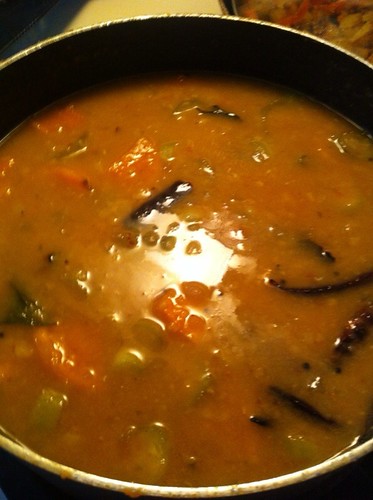
Sambar - South Indian Vegetable Stew

Sambar

During my childhood, sambar was such a staple in my house, that I used to hate it! Can't believe I love it so much when I started preparing it on my own. So easy to prepare and you really don't need anything else when you have it with rice. Goes very well with idlis too. (I hated idlis too, but I still brought an idli thattu (idli maker) all the way from Pathanamthitta to New Jersey, so I better well make some!)

Credit: I followed Vazhayila's recipe to the T. Came out just like the way my mom used to make it.

Ingredients:
Split Red Lentils (Split Masoor Dal) or Split pea lentils (Toor Dal) - 1 cup
Turmeric powder - a pinch
Salt to taste
Water - 1 1/2 cup
Oil - 1 tablespoon
Onion chopped - 1
Green chili - 2-3
Vegetables chopped - 2 cup (any veg of your choice, i prefer carrot, potato, ashgourd (padavalanga), drumstick (moringa oleifera), ivy gourd (tindora/kovakka), french beans)
Tomato - 1 or 2, chopped
Tamarind pulp - 1/2 tablespoon
Sambar powder - 2 table spoon (storebought or homemade)
Asafoetida (Hing) - a large pinch
Salt to taste

For Tempering:
Oil
Curry leaves
Mustard seeds
Dried red chili  - 2

Method:
Wash and drain lentils. Add lentils with salt and pressure cook with just enough water for 3 to 4 whistles. If you don't have a pressure cooker, you can use a regular saucepan and cook the dal until its soft.
Heat a tablespoon of oil in a large dutch oven and saute onion and green chilies for a couple of minutes.
Add diced vegetables and saute for 2-3 minutes, followed by tomato.
Dissolve tamarind pulp in 1/4 to 1/2 cup of warm water and mix with Sambar powder.
Add this along with cooked lentils to the pot, with just enough water. Bring it to a boil, lower the heat to medium-low, cover and let simmer for 20 mins.
Uncover when cooled, simmer again for a couple of minutes, add a pinch or two of asafoetida and chopped cilantro (optional).
Tempering:-Heat oil in a pan and add mustard seeds. When it starts to splutter add red chilies and curry leaves. Pour it over the sambar. Serve hot (or some people like it cold too) with Idlis, Dosa or Rice.

Monday, August 20, 2012

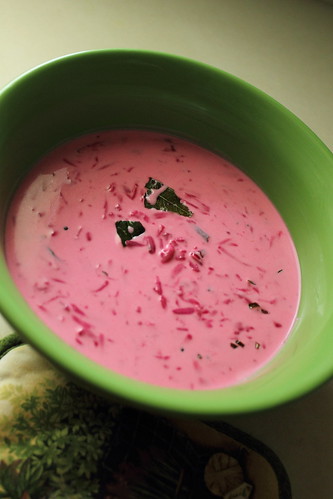
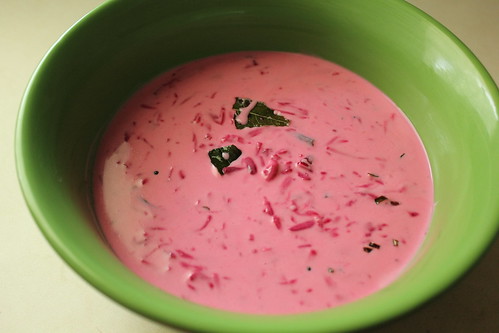
Beetroot Pachadi - Beetroot in Yoghurt sauce


Beetroot Pachadi 
Ingredients:

Beetroot - 2 nos.
Yogurt - 1 cup
Red onion - 1/2, chopped
Ginger - 1 small piece, chopped
Green chillies - 2 or 3 chopped
Mustard seeds - 1/2 tsp
Cumin seeds - 1/4 tsp
Dry red chilli - 2
Curry leaves - 1 sprig
Oil -1 tbsp.
Salt to taste

Method:
Boil the betroots in a saucepan with water. Cook for about 15 minutes or till you are able to stick a fork into it, but is not too mushy. Take it off the heat, drain the hot water, and pour cold water in it. Once it has cooled down, grate the beetroot. Whip yoghurt in a bowl with salt and a little water.
Heat oil in a pan, splutter mustard seeds. Then add cumin seeds, dried red chilies and curry leaves. Then add onions, ginger and green chilies and saute for about 4-5 minutes till the onions soften. Add grated beetroot and saute for a minute or two, Turn off the heat and allow to cool down. Add it to the whipped yogurt and mix.

Beetroot pachadi