Butter Croissants and Coffee

One of the most best aromas on a beautiful morning

Samosa Chaat

Snack a little

Seekh Kabab

Try something different!

Decadent Chocolate

Do not forget to indulge once in a while

Steamed goodness

Various cooking methods bring variety in your palette

Showing posts with label potato. Show all posts

Wednesday, February 4, 2015

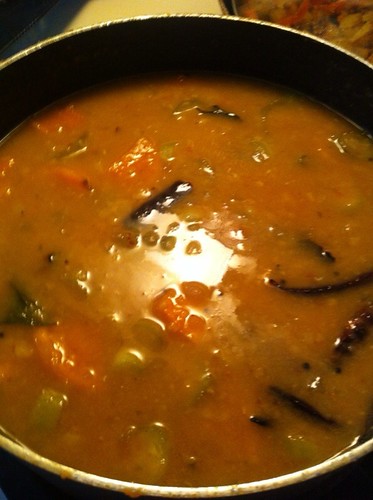
Zero-oil Tomato Sambar


I've made this sambar a few times now. Its a one pot meal that requires no effort except for prepping the veggies. When in a hurry, I only use tomatoes and make a tomato sambar. You can add additional veggies to this recipe.
Veggies that go well in this sambar are spinach, carrots, beans,  snake gourd (padavalanga), drumsticks, ivy gourd (tindora/kovakka),sweet potatoes, potatoes, taro (cheppankezhangu/chembu/arbi), bell pepper, green peas.

Ingredients:
Lentils – 1 cup (use toor dal/masoor dal/moong dal/ or a mixture of these)
Tomatoes – 3, chopped
Onions – 1, chopped
Green chillies – 3, chopped fine
Ginger – 1″ thick, minced
Garlic – 4 cloves, minced
Curry leaves – 1 sprig
Sambar powder – 3 tbsp.
Turmeric powder – 1/2 tsp
Asafoetida – 1 tsp
Water – 2 cups
Additional veggies are optional – eg. carrots, beans, snake gourd (padavalanga), drumsticks (moringa oleifera), ivy gourd (tindora/kovakka), sweet potatoes, potatoes, taro (cheppankezhangu/chembu/arbi), bell pepper, green peas.
Salt to taste
Cilantro – a handful, chopped

Method:

Add all ingredients into a pressure cooker and cook for 2 to 3 whistles. After it’s cooked, sprinkle the cilantro over the top – do not forget this step because it lends the tomato sambar that signature flavor. It’s that simple!

You can have it with brown rice, and a side of other veggie dishes. Or on its own like soup.

Sunday, January 12, 2014

Parmesan Roasted Potatoes


Another recipe I made last Christmas and again this year. This was served as a side to my main course of herb marinated lamb rack.

Ingredients:
4 cups cubed Yukon Gold potatoes
3 tbsp olive oil
1/2 tsp garlic salt
1/2 tsp salt
2 tsp paprika
1 tsp pepper
4 tablespoons freshly grated Parmesan cheese

Method:
Preheat your oven to 425 degrees.
Place the cubed potatoes into a baking dish. (The cubes of potatoes should be about 3/4 of an inch on all sides) You can spray the baking dish with a baking spray too to eliminate anything possibly sticking
Pile on the olive oil, garlic salt, salt, paprika, pepper and Parmesan cheese. Using your fingers, or a spoon if you feel inclined, get in to the potatoes and carefully mix everything around until the seasonings coat each potato.
Transfer the baking dish into the oven and bake for 15 minutes. Remove from the oven and toss the potatoes with a pair of tongs. Put the baking dish back into the oven and bake for 10 minutes more. Remove the baking sheet and give them another toss and place them back in the oven and roast until they are golden and crispy.
Season with an little dusting of sea salt and extra parmesan cheese and serve.


Sunday, December 22, 2013

Blanquette de Veau - Veal Stew


I picked up some veal stew meat on one of my trips to the grocery store. With the cold weather outside, I felt like having something warm and comforting for dinner. I looked up a few veal recipes on Epicurious and elsewhere on the web, and I decided to go with the Blanquette de Veau. It's a French dish which basically means veal stew. The rule is to keep it as 'white' as possible, so refrain from any green garnishes. Also it's traditionally served with rice to soak up the gravy. Its a little bland for an Indian palette, so I was worried if Bee would like it. But to my relief, he loved it!! I did make a few changes to the original recipe though, which I will mention in notes below. I brought a slight Kerala twist to the stew, which not only brought good flavor, but also made it slightly more simpler. This took me roughly 2 hours to prepare from start to finish.

Ingredients:
Veal - roughly 1 lb. or 1/2 kg, cut into 1 inch pieces
Garlic - 2 cloves
Yellow or white onion - 1/2
Cloves- 10
Carrots - 2
Leeks - 2
Potato - 1
Cremini or button mushrooms - 20 pieces
Pearl onions - 10
Lemon - a wedge
Butter - 3 + 3 tbsp
Flour - 3 tbsp
Thick coconut milk - 1/2 cup
Salt to taste

For bouquet garni:
Parsley (flat leaf) - few sprigs
Thyme - few sprigs
Bay leaf - 1
Black peppercorns - 20

Method:
Cut veal into 1 inch pieces (mine was store bought so it was pre-cut).
Note: if you get veal with bone, save the bone for using in the stock, adds a lot of flavor.
Add the veal pieces in a pot and cover with water and bring to a boil. You will notice a lot of scum forming on the top. At this stage, drain the veal and wash off all the scum. Put it back into the pot.
Prepare a bouquet garni by taking a piece of muslin cloth (i used a sterilized medical gauze, wink!) - and wrapping the parsley, thyme, bay leaf and black peppercorns in it. Tie it into a knot. Add this to the pot with the veal. Take a quarter of an onion - pierce cloves into it. Wrap this in another muslin cloth. Add it to the pot as well. Now fill it with water to cover the meat and some more for the vegetables too.
Note: If you have a veal bone, add this now to make a more flavorful stock. Alternately, you can also use chicken/beef/vegetable stock, or bouillon cubes.
Slice the garlic cloves and add it to the pot. Now bring the pot to a boil on a medium heat.
While its heating up, meanwhile, we're going to chop the veggies and add them to the pot one by one. Cut the carrots into bite size chunks, slice the remaining quarter of onion, dunk them into the pot. Wash the leeks and cut off the green part. We're using the white portion of the leeks only. Slice it and it goes into the pot. I cubed a potato as well and added it.
Note: In the traditional recipe, potatoes aren't used. But some use potatoes as a side to the stew. I wanted to add the Kerala stew twist to this, so I decided to add a potato in.
Add salt to taste. When it has started to boil, bring the heat down to almost low. Cover and cook for 1 hour and 15 mins. This is slow cooking so the veal is cooked until tender.
Note: Some like to cook the vegetables separately and then add it after the veal is slow cooked. That way, the vegetables will still have a slight crunch to them. I wasn't too worried about that, and mine didn't turn to mush either. I wasn't using a stock, so I wanted the vegetable flavours to form the stock. So it's all good!
While the veal is cooking, slice the mushrooms and peel the pearl onions. It is also a good point to get the rice started too.
When the veal is tender, strain the veal and vegetables and reserve the stock. Bring the stock back to a boil and reduce it further to about 2 cups. While the stock is reducing, it's time to saute the mushrooms.
Heat up a frying pan and melt 3 tbsp of butter. Heat the butter until the foam subsides. Add the mushroom slices and pearl onions. Saute for about 6-8 minutes until the mushrooms are cooked and still have a good crunch. Squeeze a bit of lemon juice over it.
Note: Keeping with the 'white' theme of the stew, white pearl onions are traditionally used, but I used the red ones, no biggie!
Now in a saucepan, prepare the roux. I've explained this in my fish fry in white sauce recipe, but here it is again. Heat the saucepan and melt 3 tbsp of butter. Add 3 tbsp of flour to this and whisk it. Allow it to froth and turn golden brown. The flour will be cooked in a minute or two. Now slowly pour in the reduced stock, whisking constantly as you're pouring it, to avoid lumps. You will see that the stock will thicken into a gravy.
Note: The traditional recipe, asks for a dollop of crème fraîche (fresh cream) to be added at this stage. Two large egg yolks are beaten in a bowl. Half a cup of the gravy is slowly beaten into the yolks to temper it (warm the yolks to prevent curdling). The egg yolk mixture is slowly whisked into the gravy pan, removed from heat and whisked until sauce has a creamy consistency. Lemon juice is added and seasoned with salt and pepper.
I avoided this complex step above, and used my Kerala stew twist again. I had half a cup of thick coconut milk leftover from last week's beef curry. I tempered the coconut milk by whisking in a little gravy into it. Then added it back into the gravy (prevents curdling of the coocnut milk). Add the veal and vegetables and sauteed mushrooms. Cover and let it cook for another 10 minutes so everything is combined.
Note: Some people put the veal, vegetables and mushrooms on a plate and pour the gravy over it. Some combine it. I chose the latter option.
Serve with a cup of steamed rice and enjoy! This also stores well, reheats well and makes great leftovers!

Check out my other recipes that uses roux:
Julia Child's fish fry in white sauce
Shrimp and veggie pasta casserole
Canneloni Florentine

Tuesday, December 10, 2013

Bread Upma

I haven't even heard of bread upma until the day I made it. My hubby suddenly had a craving for it, and told me about this dish that used to be very popular in Tamil Nadu during his childhood. Before chaats from north India became popular and invaded the snack scene in south India, these were a regular item in most tea shops. Nowadays, you can never find this in a restaurant menu. So he asked me to look it up and make it for him. I went through a few bread upma recipes online and mostly followed Preethi's.


Ingredients:
Bread - 6 to 8 slices
Ghee - as required
Onion - 1 medium, chopped
Green chilli - 1, chopped
Ginger - 1/2 inch, minced (optional)
Tomato - 2, chopped
Vegetables of choice - like crumbled potato, green peas, carrots, beans, chana (garbanzo), chopped and cooked. You can also add cooked ground meat.
Curry leaves - 1 sprig
Mustard seeds - 1/2 tsp
Urad Dal - 1/2 tsp
Chana Dal - 1/2 tsp
Cashewnuts - handful, broken
Turmeric powder - 1/2 tsp
Red chilli powder - 1/4 tsp
Asafoetida - 1/4 tsp
Garam masala - 1/2 tsp (optional)
Tomato puree or water - 2 tbsp
Salt to taste
Coriander leaves - minced (or coriander chutney) - to taste
Lemon juice - to garnish

Method:
Toast bread pieces on a skillet with ghee. (You can skip toasting the bread, but I felt this step made the dish really tasty!) Cube them into bite size pieces. In a wok, heat ghee and splutter mustard seeds. Add chana dal, urad dal and cashewnuts. Stir well so that they fry evenly. When they brown, add onions, ginger and green chilli. Fry till onions turn translucent with salt. Then add tomatoes and fry till they mush up. Then add cooked vegetables and combine. Add turmeric powder, asafoetida, red chilli powder and garam masala. Sprinkle some water or add tomato puree and cook for a few minutes. Finally add the cubed bread pieces and combine well. Garnish with cilantro chutney and squeeze a bit of lemon juice. Serve hot.

Sunday, March 3, 2013

Egg and Vegetable Stew (with variations for chicken, beef or lamb)

This stew is a traditional Syrian Christian curry served for breakfast with Appam (lacy rice pancakes). I like to have it any time of the day with toasted bread, if there's no ready batter for appams. It's very rustic and hearty, like the filling of a pot pie. (Maybe I will try it in a pot pie someday).


Serves: 4-6

Ingredients:
Eggs - 4 large
Onion - 1 medium size, chopped
Ginger - 1 inch, minced
Green chillies - 3 or as per your spice level
Chopped Vegetables - 2 cups (preferably potatoes, cauliflower, carrots, french beans, green peas)
Mustard seeds - 1 tsp
Cinnamon sticks - 1 large broken to small pieces
Cloves - 4-6
Green cardamom pods - 4
Bay leaf - 1
Curry leaves - 1 sprig (optional)
Black pepper corns - 6-8
White pepper powder - 2 tsp (optional)
Black pepper powder - 1 tsp
Turmeric - a pinch
Red chilli powder - a pinch (optional)
Coriander powder - 1 tsp (optional)
Garam masala - a pinch (optional)
Coconut milk - 1 cup
Water - 2 cups
Oil (vegetable/canola) - 2 tbsp (For authenticity, use coconut oil - its an acquired taste)

Method:
Hard boil the eggs and keep aside to cool. Meanwhile chop all the vegetables and store in a mixing bowl.
In a large pot, heat 2 tbsp of oil. Add mustards seeds and let is splutter. Add the whole spices - cinnamon, cloves, cardamom, bay leaf, peppercorns. Once their aroma starts to exude, add the chopped onions, ginger, green chillies and curry leaves. Saute until the onions are translucent. Then add the powdered spices - turmeric, white pepper, black pepper, red chilli powder, coriander powder. Mix for a minute. Then add the chopped vegetables and enough water to just cover the vegetables. Cover and cook until the vegetables are cooked through. Meanwhile peel the cooled eggs and halve them, if desired. Once vegetables are cooked, reduce the heat, and pour coconut milk. Let it cook and reduce until you get the desired consistency of gravy. Finally sprinkle garam masala and add the hardboiled eggs. Serve with appams, chappathis or toasted slices of bread.

Note: You can make different variations of this stew. Leave the eggs out and it becomes a vegetable stew. Add cubed chicken pieces instead of the vegetables and it becomes a chicken stew. For beef or lamb stew, cook the meat separately with a small amount of water or even pressure cook it, before adding it to the stew.
If you don't have coconut milk, use regular milk.


Sunday, October 14, 2012

Punjabi Samosa


Ingredients:

For stuffing:
Potatoes - 6, medium
Green peas - 1/2 cup
Oil - 1 tbsp
Cumin Seeds - 1/2 tsp
Asafoetida - a pinch
Red chilli powder - 1/2 tsp
Green chillies - 3-4 (increase or decrease according to your spice level)
Ginger - 1/2 inch piece
Fennel Seeds - 1/2 tsp
Turmeric powder - a pinch
Crushed black peppercorn - 1/4 tsp
Garam masala - 1 tsp
Amchur (dry mango) powder or Anardana (dried pomegranate seeds) powder - 1/4 tsp
Coriander powder - 1/2 tsp
Crushed dry roasted coriander seeds - 1 tbsp (optional)

For samosa cover:
All purpose flour - 1 cup
Wheat flour (Aata) - 1 cup
Salt - 1 tsp
Carom seeds (Ajwain) - 1 tsp
Oil - 4-5 tbsp
Water - about 1/4 cup

Oil for deep frying

Method:


Dough for the samosa wrappers:
In a mixing bowl, mix 1 cup all purpose flour and 1 cup wheat flour together. You can also use 2 cups of all purpose flour and leave out wheat flour. Add salt, carom seeds and  oil. Mix well with your hands, it will become crumbly. Add a little water and knead it to a firm dough. Cover and leave for 15-20 mins.


Make the filling:
Wash and peel potatoes. Pressure cook with salt and enough water to cover the potatoes, for about 4 whistles. Or you can boil them on an open stockpot till its cooked.
Drain and mash roughly. You need to have some chunks in there too.
Grind green chillies and ginger into a paste.
Heat 1 tbsp of oil in a pan on medium heat. Add cumin seeds, asofoetida, red chilli powder and fennel seeds. Allow it to temper for 10 seconds and add the green chilli - ginger paste. Sauté for few seconds and add green peas, turmeric powder and coriander powder. Cover and cook for 2 minutes. Now add the mashed potatoes and mix. Add garam masala, amchur/anardana, black pepper. Taste and adjust salt. Mix well and take off heat. Let it cool down completely.


Make the samosas:
Roll the dough into lemon sized balls. Now roll it out with a rolling pin into an circular or elliptical shape. Cut it in half with a knife. Fold the cut edge in half and stick them together. You can dab some water for help in sticking. It should form a nice cone shape. Fill this cone with the stuffing in keep it compact. Then pinch and fold a portion of the outer edge. Then pinch from two sides and close together in the middle. Pull the edge up a little. You can refer Sanjeev Kapoor's video recipe below to understand this technique. From 8:08 onwards.


Heat oil in a deep wok or frying pan to a medium heat. Deep fry the samosas till they turn an nice golden brown color.

Serve with date and tamarind chutney and/or coriander-mint chutney. If you don't have these chutneys, you can use ketchup as well.
Or you can use these to make an amazing Samosa Chaat.
Enjoy! :)

Notes: You can store these samosas in the refrigerator for a couple of days, and fry them whenever you're ready to eat.
Oil can be any vegetable oil like canola oil or even olive oil for a healthier option.
You can even bake these samosas instead of deep frying for a healthier snack. Just pre-heat the oven to 400°F, and bake the samosas on a baking sheet for 15-20 mins until they're golden brown.


Friday, September 14, 2012

Sambar - South Indian Vegetable Stew

Sambar

During my childhood, sambar was such a staple in my house, that I used to hate it! Can't believe I love it so much when I started preparing it on my own. So easy to prepare and you really don't need anything else when you have it with rice. Goes very well with idlis too. (I hated idlis too, but I still brought an idli thattu (idli maker) all the way from Pathanamthitta to New Jersey, so I better well make some!)

Credit: I followed Vazhayila's recipe to the T. Came out just like the way my mom used to make it.

Ingredients:
Split Red Lentils (Split Masoor Dal) or Split pea lentils (Toor Dal) - 1 cup
Turmeric powder - a pinch
Salt to taste
Water - 1 1/2 cup
Oil - 1 tablespoon
Onion chopped - 1
Green chili - 2-3
Vegetables chopped - 2 cup (any veg of your choice, i prefer carrot, potato, ashgourd (padavalanga), drumstick (moringa oleifera), ivy gourd (tindora/kovakka), french beans)
Tomato - 1 or 2, chopped
Tamarind pulp - 1/2 tablespoon
Sambar powder - 2 table spoon (storebought or homemade)
Asafoetida (Hing) - a large pinch
Salt to taste

For Tempering:
Oil
Curry leaves
Mustard seeds
Dried red chili  - 2

Method:
Wash and drain lentils. Add lentils with salt and pressure cook with just enough water for 3 to 4 whistles. If you don't have a pressure cooker, you can use a regular saucepan and cook the dal until its soft.
Heat a tablespoon of oil in a large dutch oven and saute onion and green chilies for a couple of minutes.
Add diced vegetables and saute for 2-3 minutes, followed by tomato.
Dissolve tamarind pulp in 1/4 to 1/2 cup of warm water and mix with Sambar powder.
Add this along with cooked lentils to the pot, with just enough water. Bring it to a boil, lower the heat to medium-low, cover and let simmer for 20 mins.
Uncover when cooled, simmer again for a couple of minutes, add a pinch or two of asafoetida and chopped cilantro (optional).
Tempering:-Heat oil in a pan and add mustard seeds. When it starts to splutter add red chilies and curry leaves. Pour it over the sambar. Serve hot (or some people like it cold too) with Idlis, Dosa or Rice.

Wednesday, January 4, 2012

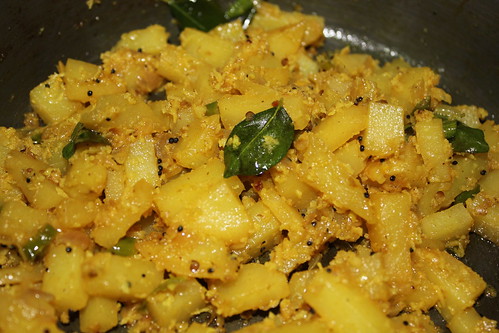
Potato Thoran - Potato stir-fried with coconut

2nd January 2012
Happy New Year!
Just got back from the place where I grew up - Riyadh. Its probably the last time I would visit this country, so feeling a bit sad and homesick.
I made sure I jotted down most of the recipes of what my mom cooked during my stay :)
Will post em when I make it on my own and take a picture of it.
Had an annoying journey back, with a 5 hour long wait in Mumbai.
Reached home and a serious jet lag set in. So I just logged in to work from home and set my status as 'Away. Call if urgent' and went to sleep.
Woke up 4 hours later but still feeling tired. I had brought some of my mom's fried prawns and beef cutlets. So dinner was almost set. I cooked some rice, made some kerala dal and wanted a thoran too. As there was no vegetable available in the fridge, I saw a few potatoes lying in my vegetable rack. I had no idea if a potato thoran even existed. But what the hell, I just googled it and apparently it does exist lol.
So I gave it a try since its really no effort if you have some grated coconut lying around in the freezer.

IMG_3254

Ingredients:

Potato - 1 large
Grated coconut - 1/2 cup
Shallots - 2-3
Garliic - 1 large clove
Green chillies - 2-3
Mustard seeds
Turmeric powder
Curry Leaves

Method:

Peel potato and cut into long thin slices. Put in a bowl of water to avoid discoloration.
Chop shallots, green chillies and mince garlic.
Heat oil in a pan and add mustard seeds to splutter. Add shallots, green chillies and garlic. Stir for 3-4 minutes on medium heat.
Add potatoes and mix. Then add grated coconut, turmeric powder and curry leaves. Stir, and bring everything to center of the pan. Pour about 2-3 tablespoons of water into the pan, cover and allow to cook for about 5-8 minutes. Wait till water almost dries up and mix again. Serve with rice.

Saturday, May 14, 2011

Potato Masala for Masala Dosa / Samosa / Poori Masala/Baaji


Credit: http://niyasworld.blogspot.com/2010/01/masala-dosa.html


Ingredients:


2 tablespoon oil
2 teaspoon mustard seeds
1 teaspoon urad dal
2 teaspoon channa dal
1 spring curry leaves
1/2 teaspoon turmeric powder
5 green chillies, slit lengthwise
1 - inch ginger, finely chopped
500 g potatoes ( boiled with a little turmeric powder )
3 onions, sliced
Salt to taste

Method:

Heat oil in a kadai ( deep pan ). When it is hot enough add mustard seeds. When they start splutter add urad dal, channa dal, green chillies, curry leaves and chopped ginger. Saute for 2 - 3 minutes ( till dals are light brown ).

Add sliced onions. When the onions are light brown in color add turmeric powder and fry well.

Add boiled and mashed potatoes. Add salt to taste and mix well. Cover with a lid and cook on a low heat for 5 - 8 minutes.

My note: Add green peas too after adding potatoes if you like. Also you can add coriander leaves for added taste.

Saturday, April 2, 2011

Dum Aloo

Was watching the world cup final tonight, but had to cook something quick for dinner too. Kitchen hardly had any stuff that I could work with.. found 3 potatoes and tried to look for some curry that can go with rice, as I dont think I can make chappathis with all this excitement.
Decided to make Dum aloo with Tomato sambar.

Credit: http://www.indianvegetariankitchen.com/2009/01/dum-aloo.html

Ingredients:

Potatoes-3 small(pressure cooked, peeled and cut into big pieces)
Salt
Oil-2 tbsp
Curd/Yogurt-2 tbsp
coriander leaves- to garnish
Kasuri methi(optional)-a pinch(crushed)
Lime juice-from 1/2 lime(optional)

Spice powders(adjust the quantities according to your taste)
Turmeric powder- 1/4 tsp
Kitchen king masala-1 and a half tsp (I used 1/2 tsp cumin powder and 1/2 tsp pepper powder instead)
Garam masala powder-1/2 tsp
Coriander powder-1 tsp
Red chilli powder

To grind(without adding water) into a paste:
Onion-1/2 cup
Ginger-1 inch piece
Garlic-2 pods
Green chilli-1

To grind separately into a paste:
Tomatoes-2 medium sized or 3 small

Method:


Heat oil in a pan. Add onion-ginger-garlic paste. Fry for 5 minutes.
Then add tomato paste and spice powders and salt. Bring the mixture to a boil. If the mixture is too thick, add water and bring it to a desired consistency. Simmer and cook until the raw smell is gone. It will take at least 30 minutes approximately.
Add yogurt, potatoes and cook for 5 more minutes. Garnish with coriander leaves, kasuri methi and squeeze lime juice. Serve with rotis.

Note: Add curd in the end and cook no longer than 5 minutes on very low flame to prevent the gravy from curdling.

Friday, January 7, 2011

Carrot-Potato Mezhukkupuratti : The love of Vazhayila!

One of the best blogs that I have found for the traditional Syrian Christian Kerala recipes are from vazhayila.blogspot.com This one is almost like a cooking bible for me. Most of the recipes are the simple foods that my mom used to cook everyday in our kitchen in Riyadh, Saudi Arabia. My sister and I took them for granted and complained about eating such boring food when I could try something continental or north indian or mughlai or italian or mexican.... And then those horrible hostel days while studying engineering where most of us would complain at the spiciness or the tasteless food.
But now looking back at those days, I remember that despite all those complaints, we used to eat to our content and some of those staple foods actually did taste quite good, not to forget was healthy too. So now on my journey back to my roots, here are some of my favourite recipes from vazhayila.com

Credit: http://www.vazhayila.com/2010/03/carrot-potato-mezhukkupuratti.html

view original source ! Vazhayila !: Carrot - Potato Mezhukkupuratti http://www.vazhayila.com/2010/03/carrot-potato-mezhukkupuratti.html#ixzz1AM7woeLi

Ingredients:

Potato - 3 nos.
Carrot - 2 nos.
Onions chopped - 1 small
Garlic - 2 cloves
Chili powder - 1 tsp
Turmeric powder - 1/4 tsp
Garam masala - 1/4 tsp
Curry leaves 
Salt to taste
Oil

Method:

Crush Onions and garlic in a mortar and pestle.Clean and Slice the carrots lengthwise and put it in water, if not it may cause potatoes to change color.Heat oil in a pan and  curry leaves, crushed onions and garlic. Saute for 3-4 minutes. Add chili powder , turmeric powder and Garam masala and toss it well for a minute.Add drained potato , carrots , salt and 1/4 cup water. Cover it with a lid and cook for 7-10 minutes or until its is cooked and dry. Uncover and sautee for another 3-4 minutes , stirring frequently. Serve warm
Cheers!!!
My notes:
1. As I do not have a mortar and pestle, I would just slice the onions finely and add them. Garlic, I would crush them by taking the flat part of a chef's knife and apply pressure to the garlic clove. So the clove gets crushed and its easier to peel its cover away. Now add them to the recipe.
A photographic guide for dummies: http://www.garlic-central.com/garlic-crushing.html
2. I added the potatoes in water as I was more concerned about those off white little cute cubes to turn light brown.
3. You can also add some bell peppers (capsicum) - I always have some leftover and need to use them before they go bad. So I use them and it adds a wonderful flavor to this recipe.
4. The technique used here to cook potatoes is actually a very good one. Some people would also make this mezhukkupuratti by boiling the potatoes first. But boiling them first and then frying them does add the risk of overcooking them and potato will end up being very mushy and would absorb a lot of oil. So if you use this technique of sauteing the veggies first and then adding enough water to cover them in the frying pan, and allowing it to cook, you get a texture that has a slight bite but is cooked well. Serve with steamed rice and dal. Bon appetit!